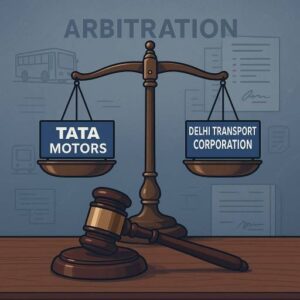
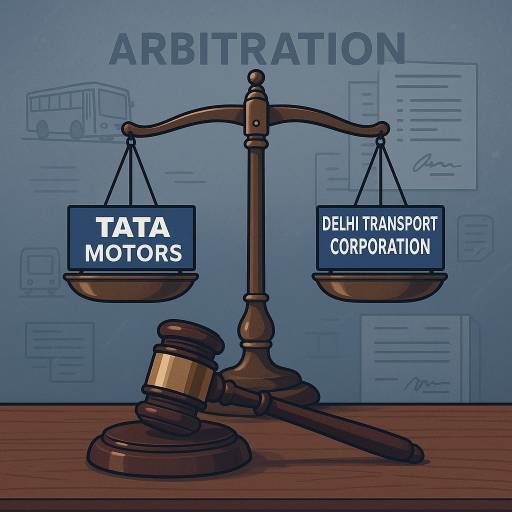
The Tata Motors vs DTC arbitration judgment by the Delhi High Court addresses critical issues of constructive res judicata and interim relief in arbitration. Tata Motors challenged DTC’s recovery of penalties from AMC dues, despite a prior arbitral award declaring such deductions illegal. DTC argued that relief under Section 17 was barred due to TML’s withdrawal of a Section 9 petition. The Court rejected this, holding that no adjudication had occurred and the withdrawal was part of a mutual arrangement. Upholding the Arbitral Tribunal’s consistent orders, the Court emphasized procedural fairness and affirmed the tribunal’s discretionary power to grant interim relief.
In the evolving landscape of arbitration law, the Tata Motors vs DTC arbitration judgment stands as a pivotal decision. While commercial disputes are increasingly being resolved through arbitration, interim reliefs and their limits remain widely contested. In this case, the Delhi High Court was called upon to decide whether interim relief could be granted under Section 17 after a party had withdrawn a previous Section 9 petition. As a result, the judgment addressed essential concerns regarding constructive res judicata and the powers of arbitral tribunals.
Moreover, the court explored whether a party that had earlier conceded certain claims could still approach the arbitral tribunal for relief. Consequently, the case drew attention to how interim concessions, made to avoid litigation or contempt, should be treated in subsequent proceedings. Therefore, this judgment does not merely resolve a dispute between Tata Motors and Delhi Transport Corporation—it sets a precedent for interpreting arbitration law more broadly.
Furthermore, the court clarified that interim applications under Section 17 are not necessarily barred by earlier withdrawals. Accordingly, it emphasized that mutual arrangements between parties cannot be construed as permanent concessions. Hence, it upheld the arbitrator’s discretion to restrain recoveries even where prior litigation had occurred. Because of this clarity, the Tata Motors vs DTC arbitration judgment serves as a guidepost for future arbitration disputes.
Ultimately, the ruling reinforces the principle that arbitral tribunals must maintain autonomy over interim measures. Thus, parties cannot use past litigation strategy to unfairly block access to interim relief.
To understand the Tata Motors vs DTC arbitration judgment, one must examine the roots of the dispute. Initially, Delhi Transport Corporation (DTC) entered into a contract with Tata Motors Limited (TML) in 2018. Under this agreement, TML supplied 1625 CNG-fueled buses and provided maintenance services. While the agreement covered supply and upkeep, issues soon arose over performance metrics. Specifically, DTC imposed penalties for allegedly poor fuel efficiency under Clause 24.4 of the contract. Consequently, DTC began deducting amounts from TML’s Annual Maintenance Charges (AMC) citing low KMPKG.
However, TML disputed the deductions, arguing that DTC used flawed calculations. Instead of actual kilometers run, DTC relied on driver memos. Therefore, TML challenged the deductions and referred the matter to arbitration. In 2017, the arbitral tribunal ruled in TML’s favor, holding the deductions illegal. Nevertheless, DTC continued making fresh demands for different periods. As a result, further arbitration proceedings were triggered.
Subsequently, DTC raised a new demand of ₹127 crores in 2021, reviving the same penalty basis. In response, TML sought interim protection under Section 9 of the Arbitration Act. Although the matter was initially stayed, it was later withdrawn as part of a mutual understanding. Even so, DTC again attempted to recover penalties unilaterally. Consequently, TML filed multiple applications under Section 17 before the arbitral tribunal.
Ultimately, both parties filed appeals under Section 37 against the tribunal’s order dated 17.03.2023. Hence, the Tata Motors vs DTC arbitration judgment arose from a long-standing contractual and procedural conflict.
Following the initial arbitral award in 2017, the dispute between Tata Motors and DTC escalated further. Consequently, DTC issued fresh demands totaling ₹127 crores in 2021, excluding prior periods covered in the earlier award. In response, TML filed a Section 9 petition to restrain recovery; however, that petition was later withdrawn. Even so, DTC resumed deductions from TML’s AMC dues in early 2023, prompting a new round of interim applications.
Therefore, Tata Motors approached the Arbitral Tribunal under Section 17 to stay these fresh deductions. As a result, the tribunal restrained DTC from recovering certain amounts, while directing TML to furnish bank guarantees. Moreover, DTC did not challenge the earlier Section 17 orders passed in November 2022 and February 2023. Instead, it raised further demands and recoveries, leading to additional litigation.
Meanwhile, DTC argued that the relief now sought was barred by constructive res judicata due to the earlier withdrawal. Nevertheless, the tribunal passed a consistent third order on 17.03.2023, again restraining recoveries and rejecting TML’s refund request. Subsequently, both parties challenged this order under Section 37 before the Delhi High Court.
Thus, the Tata Motors vs DTC arbitration judgment became a test case for the tribunal’s powers and the res judicata principle. In this context, the Delhi High Court’s ruling was awaited to clarify the scope of interim reliefs. As a result, the dispute reached a critical legal juncture, combining contractual enforcement with procedural fairness. Ultimately, these developments laid the groundwork for a significant judicial pronouncement.
Following the third Section 17 order passed by the Arbitral Tribunal, both parties filed appeals under Section 37. As a result, Tata Motors Limited (TML) and Delhi Transport Corporation (DTC) approached the Delhi High Court. While DTC challenged the tribunal’s restraint on recoveries, TML contested the refusal to order a refund. In particular, DTC argued that the relief sought by TML was barred by constructive res judicata. For this reason, it claimed that TML’s earlier withdrawal of the Section 9 petition precluded similar relief later. Moreover, DTC relied on earlier judgments to support its view. However, the High Court carefully reviewed the facts and procedural history. As a consequence, it found that the Section 9 petition was withdrawn as part of a mutual arrangement. Therefore, the Court held that such withdrawal did not amount to abandonment of rights. In the same way, the Court noted that earlier Section 17 orders remained unchallenged by DTC. Accordingly, the tribunal acted consistently in restraining further recoveries. On the other hand, the Court also examined TML’s claim for a refund of already deducted sums. However, it found that the tribunal refused that relief not due to lack of power but on merits. Consequently, the Court upheld the Arbitral Tribunal’s discretion on both counts. Because of this, it dismissed both appeals while ensuring procedural integrity. Thus, the Tata Motors vs DTC arbitration judgment reaffirmed that arbitral tribunals can grant fair interim reliefs without res judicata limitations.
To begin with, the Delhi High Court had to address multiple intertwined issues in the Tata Motors vs DTC arbitration judgment. First and foremost, it had to determine whether the relief sought by Tata Motors under Section 17 was barred. Specifically, the question arose because TML had earlier withdrawn its Section 9 petition unconditionally. As a result, DTC contended that such withdrawal created a bar under the doctrine of constructive res judicata. Furthermore, DTC argued that TML could not seek the same relief again before the Arbitral Tribunal. In addition to that, DTC claimed that the tribunal lacked the authority to grant interim relief of this nature. On the contrary, TML asserted that the earlier withdrawal was part of a mutual settlement. Consequently, it maintained that no legal adjudication had taken place on the substantive issue. Therefore, the res judicata principle could not apply in the present context.
Moreover, the court also had to consider whether the Arbitral Tribunal had jurisdiction to grant interim mandatory injunctions. While TML claimed the tribunal erred in refusing refund of deducted amounts, the tribunal had acted on merits. Thus, the issue was whether such interim refund could be ordered despite the absence of a substantive counterclaim. At the same time, the tribunal’s earlier unchallenged Section 17 orders added weight to TML’s position. Ultimately, the Tata Motors vs DTC arbitration judgment had to resolve whether procedural withdrawals could curtail rightful interim protection. In conclusion, the court’s determination on these complex procedural issues became central to the overall dispute.
To begin with, the Court noted that the Arbitral Tribunal had passed three consistent Section 17 orders. As a result, the Delhi High Court emphasized the importance of consistency in interim reliefs granted during arbitration. Moreover, since DTC had not challenged the two earlier orders, the Court found their objections unconvincing. In addition to that, the Court rejected DTC’s argument of constructive res judicata, citing the absence of any adjudication. Consequently, the earlier withdrawal of the Section 9 petition could not bar TML’s Section 17 application. Furthermore, the Court clarified that a mutual arrangement cannot be treated as a final concession on substantive rights.
Therefore, the Court held that TML was not estopped from seeking interim protection during the ongoing arbitration. On the other hand, the Court also addressed TML’s challenge to the denial of refund by the Tribunal. Although TML argued that interim mandatory relief was wrongly denied, the Court disagreed. In fact, the Tribunal did not reject the relief for lack of power, but based on merits. Hence, the denial of refund could not be faulted, especially in the absence of a counterclaim.
Because of this, the Court concluded that the Tribunal had exercised its discretion judiciously. Accordingly, both appeals were dismissed, and pending applications declared infructuous. In summary, the Tata Motors vs DTC arbitration judgment reinforces that arbitral tribunals retain broad discretion in granting interim reliefs. Ultimately, the decision underscores the limited scope of res judicata in arbitral proceedings and upholds procedural fairness.
To begin with, the Tata Motors vs DTC arbitration judgment clarifies the limited scope of constructive res judicata in arbitration. As a result, the Court held that withdrawing a Section 9 petition does not bar relief under Section 17. More importantly, since the withdrawal was part of a mutual arrangement, it did not reflect abandonment of legal rights. Therefore, the Tribunal was right in entertaining TML’s Section 17 application for interim protection.
Moreover, the judgment highlights that consistent, unchallenged interim orders strengthen a party’s case for continued relief. In the same way, the Court emphasized that procedural conduct must be assessed in the correct legal context. Consequently, the Court rejected DTC’s argument that prior withdrawals acted as a permanent concession.
Additionally, the Court confirmed that arbitral tribunals possess the discretion to deny interim mandatory injunctions on merits. Though TML argued the Tribunal erred in denying refund, the Court found no legal fault. On the contrary, the Tribunal had refused the refund not due to lack of power, but due to strategic delay. Hence, parties must assert substantive claims through appropriate pleadings, not just interim applications.
All things considered, the Tata Motors vs DTC arbitration judgment protects procedural fairness while reinforcing arbitral independence. As a result, it sends a strong message against unilateral recoveries during pending arbitration. Furthermore, it promotes judicial consistency in upholding past interim orders. In conclusion, the decision strengthens the legal framework for fair and effective arbitral proceedings in India.
In conclusion, the Tata Motors vs DTC arbitration judgment delivers much-needed clarity on interim relief in arbitration. Above all, it affirms that procedural withdrawals do not permanently bar future applications for similar relief. As a result, parties can still seek protection under Section 17 despite earlier Section 9 proceedings. More importantly, the Court recognized that mutual arrangements cannot be equated with legal adjudication on merits. Consequently, the argument of constructive res judicata was rightly rejected by the High Court.
Furthermore, the Court reinforced the Tribunal’s authority to decide interim measures based on judicial discretion. In doing so, it highlighted that merits, not technicalities, must guide decisions on mandatory injunctions. Similarly, the refusal to refund already recovered amounts was upheld because TML had not filed a counterclaim. Therefore, the Court rightly held that interim applications cannot substitute for substantive relief in arbitration.
In the same way, the judgment upholds consistency in arbitral orders, especially where past relief remained unchallenged. Thus, it ensures procedural stability and discourages repetitive litigation tactics. At the same time, the decision sends a strong message against unilateral financial recoveries during arbitral adjudication. As a result, it strengthens the protection of parties against coercive enforcement during pending proceedings.
Ultimately, the Tata Motors vs DTC arbitration judgment is a balanced precedent that strengthens fairness in commercial arbitration. For this reason, it serves as a reference for both arbitrators and courts handling similar disputes. In essence, it promotes efficiency, procedural discipline, and the overall credibility of the arbitration process in India.

Chowdhry Law Offices LLP is a trusted litigation law firm in Delhi, known for its expertise in civil, criminal, and commercial matters. With 20+ years of courtroom experience, the firm offers strategic legal solutions and dedicated representation before all major courts and tribunals.
© Copyright 2025 │ Chowdhry Law Offices LLP │ All Rights Reserved
Chowdhry Law Offices LLP is a trusted litigation law firm in Delhi, known for its expertise in civil, criminal, and commercial matters. With 20+ years of courtroom experience, the firm offers strategic legal solutions and dedicated representation before all major courts and tribunals.
© Copyright 2025 │ Chowdhry Law Offices LLP │ All Rights Reserved